How can ultrasonic signals be made audible to the human ear?
Ultrasound lies above the human hearing range. To enable acoustic evaluation, the SONAPHONE converts ultrasonic signals into an audible frequency range. Two methods are available for this purpose:
Heterodyne method
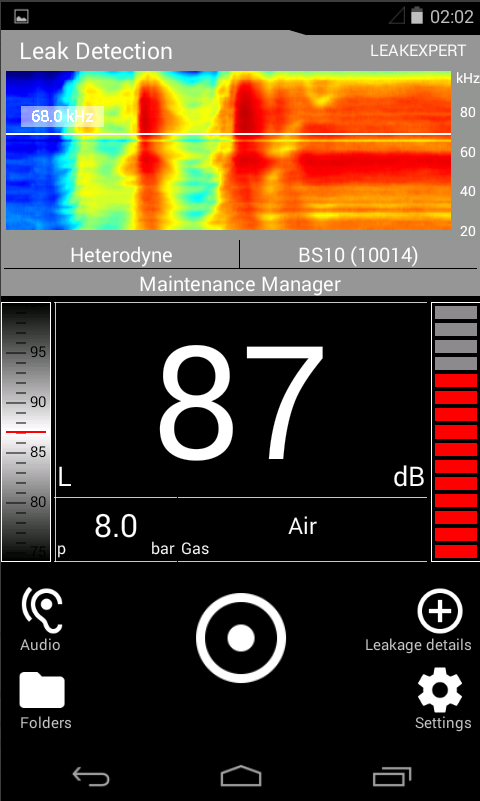
The heterodyne method selects a narrow ultrasonic frequency range and shifts it into the audible range. The desired frequency range can be selected in the spectrogram.
This method is particularly suitable when a specific frequency range needs to be monitored, for example during leak detection or when evaluating bearing noise.
Phase vocoder method
The phase vocoder method compresses a broader ultrasonic frequency range and transfers it into the audible range. This preserves the acoustic impression of a wider frequency range instead of reproducing only a narrow section.
The two methods produce different acoustic impressions. The converted signals can be played back through the loudspeaker or headphones and recorded for documentation.
Detailed answer
Signal processing can be used to convert ultrasonic vibrations into a secondary “down-mixed” signal within the audible frequency range.
With the heterodyne method, a narrow frequency band in the ultrasonic range is selected, for example a center frequency of 40 kHz ± 2 kHz, and transformed into the audible range using difference frequencies. This method is used in traditional analog testing devices that operate within a narrow band around 40 kHz.
The broadband digital SONAPHONE incorporates this approach. By shifting the center frequency using the movable line in the spectrogram across the broadband range from 20 to 100 kHz, the corresponding narrowband audible signal can be selected.
In many cases, the heterodyne method already allows a qualitative assessment based on the perceived sound, for example during leak detection or the basic evaluation of bearing defects.
In most cases, ultrasonic signals are distributed across a broad frequency range. This means that the information contained in the acoustic signal cannot be captured completely within a narrow frequency band.
For this reason, the broadband SONAPHONE also supports audible conversion using the phase vocoder method. With this method, the entire frequency range from 20 to 100 kHz is compressed by a factor of 32. Despite a small loss of information, the original broadband acoustic situation can be reproduced, providing an audible impression of the entire ultrasonic frequency range.
The two methods produce different acoustic impressions. The signal can be monitored using the integrated loudspeaker or headphones. The sampling rate of the audible signals is 8 kHz.
The volume of the converted signal changes in a similar way to the intensity of the original high-frequency signal. The temporal variation of the original signal is also retained, allowing the dynamics of the process to be reflected in the audible signal.
The SONAPHONE also records the audible signals. They are stored in WAV format and can therefore be used for further processing.