What does the leak-rate unit mbar·L/s mean, and how can it be converted into other units?
mbar·L/s means “millibar liters per second.” The unit describes a leak rate as a pressure-volume flow rate.
In simplified terms, a leak rate of 1 mbar·L/s corresponds, at a pressure of approximately 1 bar, to a volumetric flow rate of about 1 cm³ per second.
The unit is used particularly in vacuum technology and leak testing. It is not simply a pressure unit and cannot be equated directly with a volumetric flow rate in L/min.
Conversion examples
The following conversions apply:
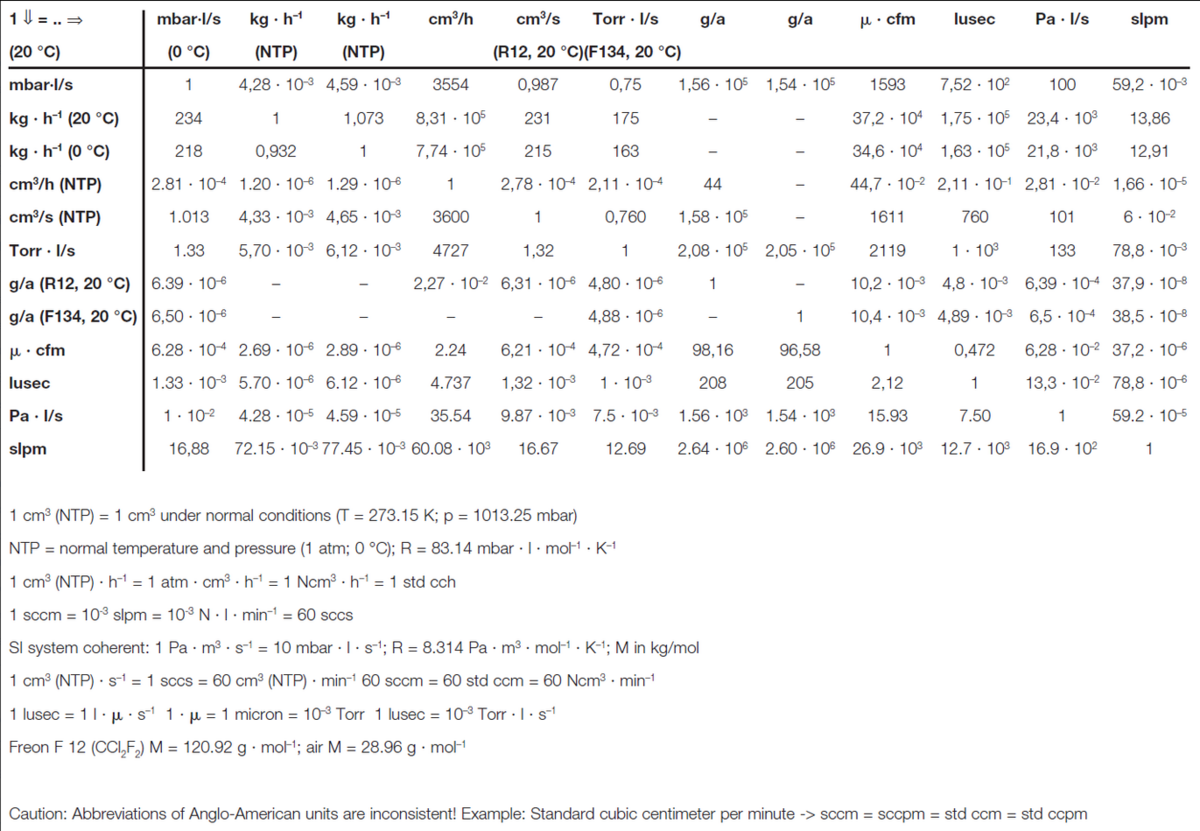
- 1 mbar·L/s = 0.1 Pa·m³/s
- 10⁻² mbar·L/s = 10⁻³ Pa·m³/s
Under reference conditions of approximately 0 °C and 1,013.25 mbar:
- 1 mbar·L/s ≈ 0.059 L/min
- 10⁻² mbar·L/s ≈ 0.00059 L/min
- 10⁻² mbar·L/s ≈ 0.59 mL/min
Conversion into a volumetric flow rate depends on the applicable pressure and temperature. The reference conditions must therefore always be specified for an accurate conversion.
Difference from L/min
When assessing leaks in compressed air systems, the loss is often expressed in L/min. This value is easier to understand because it describes the volume of gas escaping per minute.
However, it must be clearly stated whether the value refers to the actual operating conditions or to standardized reference conditions. There is no universally valid conversion from mbar·L/s to L/min unless the relevant pressure and temperature conditions have been defined.
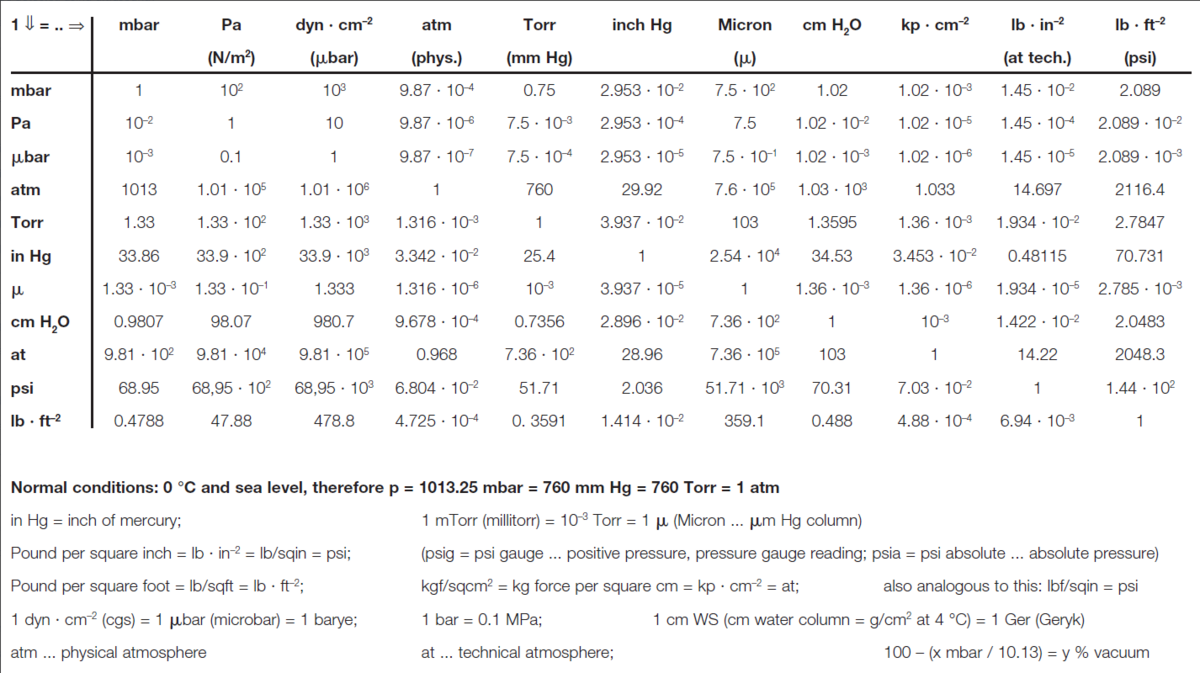
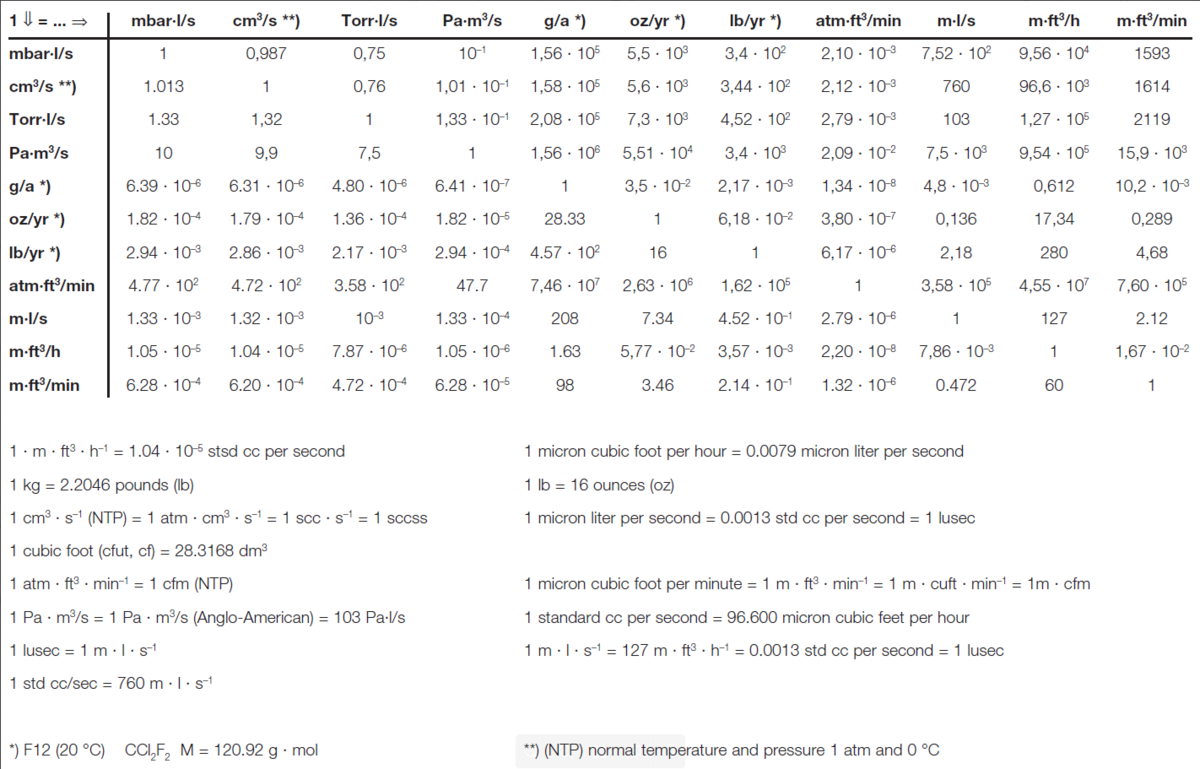
Further conversion possibilities from mbar * l/s to other units can be found in the following tables (Source: Leybold GmbH, Fundamentals of Leak Detection, 2016):
Do you have any questions?
Feel free to contact us! We will be happy to help you.